



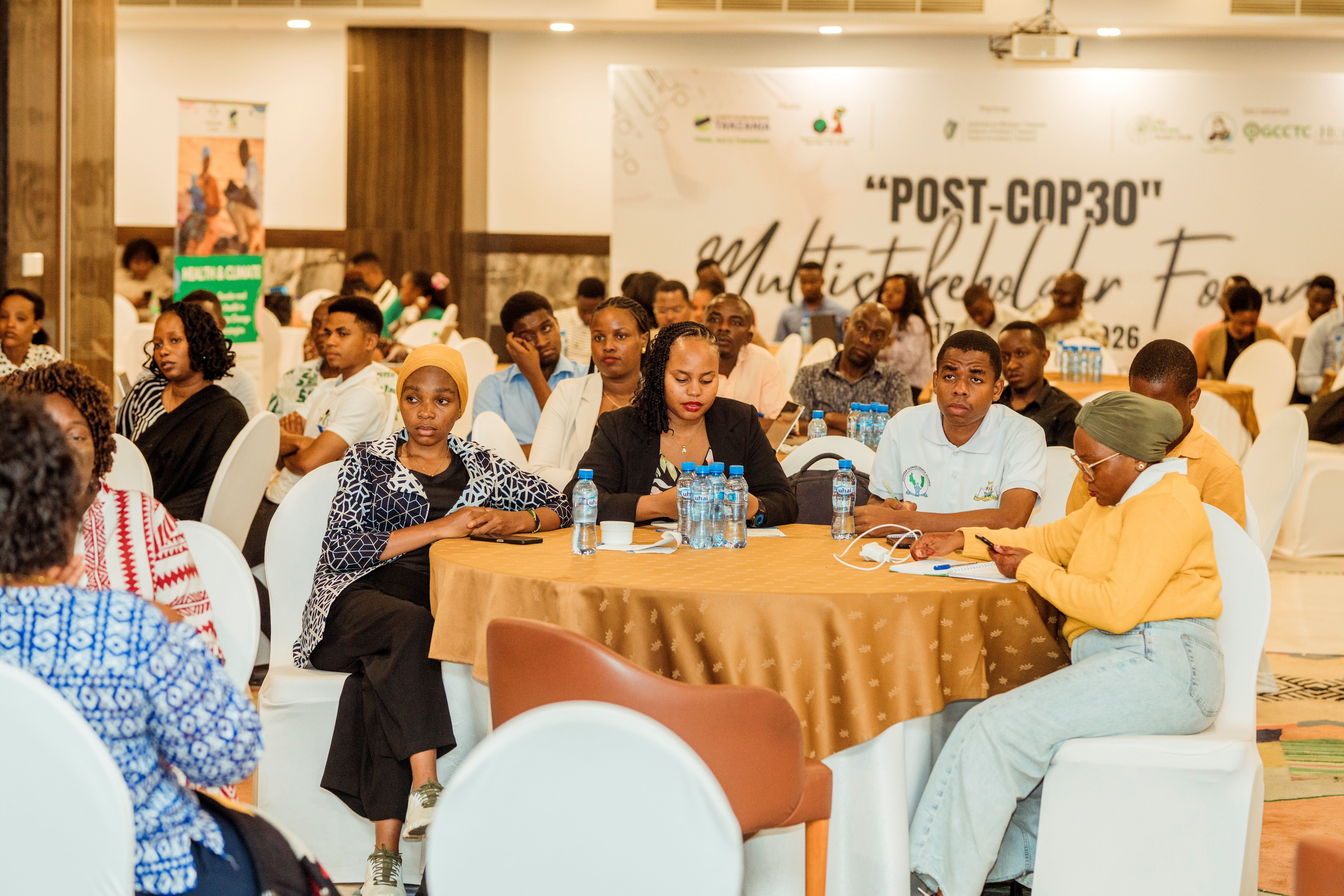
On 16th and 17th February 2026, the Climate Action Network Tanzania (CAN Tanzania), in collaboration with Women in Climate Tanzania and the secretariat, including the Climate Action Circle, Green Samia Foundation, HUDEFO, and GCCTC Tanzania, organised a Post-COP30 Multistakeholder Forum in Dar es Salaam under the theme “Localising Global Climate Solutions.”
The forum was convened following Tanzania’s participation in COP30, which took place from 10 – 21 November in Belem, Brazil, with the objective of ensuring that global climate commitments are translated into tangible national and community-level actions.
This high-level forum included Dr. Kaninzio Fredrick Manyika who served as the Guest of Honour, H.E Nicola Brennan, Ambassador of Ireland to Tanzania, Mr. Azgard Steven, Representative of Board Chair of CAN Tanzania, Dr. Sixbert Mwanga, Executive Director of CAN Tanzania; Ms. Sylviabay Kijangwa, Executive Director of Women in Climate Tanzania and more than 100 representatives from government institutions, civil society organisations, women and youth networks, development partners, academia, and the media to translate the COP30 outcomes and develop a localized action plan as the country is preparing for COP31 in Turkiye.
The Post-COP30 Forum aimed to share key outcomes and negotiations from COP30, align global climate decisions with Tanzania Development Vision 2050 and the National Adaptation Plan (NAP) 2025, strengthen coordination among stakeholders on climate finance, adaptation, mitigation, and loss and damage, and centre community voices, particularly women, youth, and marginalized groups, in climate implementation strategies.
In his speech as the Guest of Honor, Dr. Kaninzio Manyika urged youth and civil society organizations to take proactive leadership in promoting climate action that is rooted in local communities. He stressed that the post-COP meetings should not be seen merely as a reporting task; instead, they should serve as a strategic accountability mechanism to ensure that international commitments bring real benefits to Tanzanian communities. Dr. Manyika also encouraged government institutions to incorporate climate considerations into their planning and budgeting processes to promote sustainability and effective resource allocation. He called on Development Partners to increase grant-based and concessional financing and encouraged the Private Sector to view the green transition as an opportunity for growth. Finally, he urged Civil Society and Youth to drive accountability and foster innovation in the implementation of climate initiatives.
In her remarks, Ambassador Nicola Brennan highlighted the urgency of youth leadership in advancing climate justice, noting that climate change continues to intensify socio-economic vulnerabilities. “Young people must remain courageous and persistent in the pursuit of climate justice. Ireland stands shoulder to shoulder with Tanzanian youth in supporting their leadership, strengthening partnerships, and investing in solutions that deliver real impact where it is needed most,” she said.
Dr. Sixbert Mwanga noted that more than 70 percent of Tanzania’s priority agenda items presented at COP30 were reflected in the negotiated outcomes, including progress on the long-standing commitment by developed countries to significantly scale up climate finance. He emphasised that the critical next step lies in ensuring that pledged finance and technology transfer reach frontline communities. “We must ensure that climate finance and technology access reach the last mile. At the same time, we need to mainstream climate resilience across all sectoral plans so that our systems can withstand current and future climate shocks,” he stated.
Ms. Sylviabay Kijangwa underscored the persistent implementation gap affecting women in climate policy processes. While women's participation in global and national dialogues has improved, she stressed that tangible implementation at the community level remains limited.
Over the two-day forum, participants worked in thematic groups to translate key COP30 outcomes into practical, locally relevant action plans with measurable targets. Key COP 30 outcome highlights include $447.12 million and €500,000 mobilized to support climate change, the establishment of the Africa Regional Office for the Santiago Network for L&D, hosted by UNOPS in Dar es Salaam, the Loss and Damage fund will possibly provide Tanzania with 5-20 million USD, renewable energy on geothermal energy starting with Ngozi Project, a reimbursable grant of $25 million.
The groups focused on strengthening access to climate finance at the sub-national level, integrating adaptation and mitigation priorities into sectoral development plans, and closing the implementation gap affecting women and vulnerable communities. Clear indicators were proposed to track last-mile delivery of climate finance, gender-responsive implementation, and resilience outcomes across key sectors.
In addition, participants agreed to institutionalise structured youth engagement in climate accountability processes, strengthen data and monitoring systems for evidence-based reporting, and establish a multi-stakeholder coordination mechanism to review progress of the developed plan.
The forum concluded with a collective commitment to strengthen collaboration, amplify community-led solutions, and ensure that Tanzania’s climate response remains inclusive, science-based, and aligned with global ambition while rooted in local realities.